


No Cancel
Unlimited
English
Ninh Binh, apparently, is one of Vietnam’s most famous tourist attractions thanks to its wide range of cultural and natural heritages. Among these heritages, Mua Caves (Hang Múa in Vietnamese) or Dancing Cave stands out for its elegant natural beauty, because of which Mua Cave has been regarded as “The Great Wall of Vietnam” or “Tam Coc’s Muse”. This is also considered the most beautiful viewpoint in Ninh Binh, Vietnam.
Literally, Mua Cave welcomes every tourist in every single period of the year. However, according to experienced travellers, dry season (often from April to September) would be a more appropriate season thanks to its comfortable weather and low precipitation. Especially, if visitors can come to Mua Cave in May or June, they will have a high chance of seeing a breathtaking picture, in which the enormous “golden” paddy fields and majestic mountainous scenery create a harmonious combination.

Nonetheless, as a plethora of tourists would come to Mua Cave that time to observe this beautiful scene, visitors who are not into travelling with hordes of tourists may feel uncomfortable. For those visitors, they would be highly recommended to go in the rainy season (which lasts from October to March) so that they can avoid being stuck in a tourist crowd (though going in this time means you can only see the vivid green of nature instead of the golden colour of the paddy fields, which is definitely a big regret!)
When referring to Ninh Binh in general and Mua Cave specifically, one thing popping up in the Vietnamese’s minds is that it was once the Capital of Vietnam. Therefore, various Ninh Binh’s destinations may once be restricted for the Royal Family only.

Legend has it that: during the Vietnam-Mongolia war I, the Royal Family Tran moved from Thang Long (Vietnam’s Capital at that time, now is Hanoi) to Ninh Binh and Mua Cave was chosen as an entertaining place. When the King needed some entertainment, a number of beautiful dancers were supposed to come there and dance. This is the way Mua Cave got its name, which as mentioned above, literally means Dancing Cave.
Missing the beauty of the King’s entertaining place in a good day would not seem a good idea, wouldn’t it?
Mua Cave, situated under Mua Mountain, is described by the locals as “an enormous bell put upside down”. The Cave has its side of about 800 meters square. Looking from the bottom of the mountain, various white stone steps leading to the mountain’s top shape like a miniature of “China’s Great Wall”. On the two sides of this “Great Wall”, there are delicate dragon and phoenix-shaped stones, which were thought to be carved in Tran Dynasty as they reflect exactly this Dynasty’s art spirit.

Unlike other tourist destinations in Ninh Binh, Mua Cave has a charming and peaceful cultural beauty. Though this area has been exploited quite soon compared to other Vietnam’s tourist attractions, the nature here successfully keeps its pristine beauty. Thanks to the local government’s decision of sustainably developing this area’s potential tourism, tourist-care services here take place well-orderly and the local citizens are in good manners, also, there are few fighting or rip-offs witnessed.
For tourists who want to try the King’s feeling, there are music shows recreating the dancing scenery that happened in the Tran Dynasty. If tourists want to enjoy these shows, pre-check with the Cave’s managers so that you can manage your time to get there at the right time.
There are two reasons why going to Mua Cave is a “healthy” decision.
Firstly, this destination’s air is so fresh and clean. Evidently, in this hustling modern life, sometimes clean air is the silver bullet which can help “erasing” people’s all stress and pressure. Visiting Mua Cave, visitors have a chance of temporarily forgetting their busy lives to just focus on the breathtaking view there.
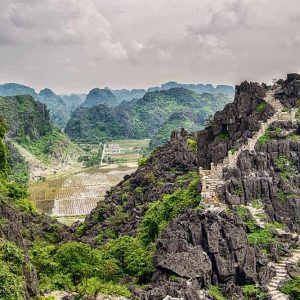
Secondly, the natural beauty here is not free-access, if you want to enjoy it, you have to “do something”. As a massive number of travellers confirmed, the most special part of Mua Cave’s experience is to enjoy the area’s nature from the view of the mountain’s peak. However, before you can get this view as a reward, you have to come through “Vietnamese Great Wall”, which means you will have to climb nearly 500 white stone steps to the mountain’s top. These white stone steps, which connect the mountain’s top and bottom parts, is like a God-made way leading to the divine world. Although this seems at first a tiring challenge, it is “the sweetest climbing challenge” as the majestic scenery observed while climbing these steps will not make you regret, absolutely.
As mentioned above, one of the reasons why the Mua Cave complex is a must-try for visitors is its pristine nature. At the very first look, Mua Cave takes people’s breath away by its “green” nature. In the middle of this Complex (which is mostly covered by numerous shade trees, providing people a relaxing atmosphere as well as resting places) lays an artificial pond. The pond has an ancient beauty, which is not only a decoration but also an “air conditioner” for this place.
After finishing to roam around the complex, you may wonder that you have seen all the most beautiful sides of “Tam Coc’s Muse”. However, only when you reach the Mua mountain’s top can the whole beauty of this destination be observed.
Standing on the top of Mua Mountain is an enormous statue of Avalokitesvara Bodhisattva, whose view is directly toward Mua Cave Complex.
This Buddhist Goddess’ situation has the meaning that the whole Mua Cave Complex is put under her divine protection. Also by looking from this mountain’s top, people can get all the magnificent sides of this area into their eyes: the golden rice paddies, the serene rivers with small boats floating, the pristine nature…., all these scenery are so wonderful that if someone have to describe, he or she would definitely refer to them as various priceless ancient artworks.
After climbing to the top of the mountain, turn right if you want a stunning place for checking in (of course you can have a check-in in mostly every place of this destination; however, interestingly, there stands a tower which is (funnily) called the “Check-in Tower”).
This tower’s architecture was made in Buddhist style, which is ubiquitous in countries where Buddhism is popular (such as India, Thailand, Laos,…). The tower’s bottom has the square shape, which represents the Land, the round top reflects the Water, the pointed parts are the symbol of Fire and the roofs over each tower’s floor remind people of the Wind’s power.
On this small tower’s walls carved the image of Nghê, one of the Dragon’s nine sons. Nghê’s appearance takes inspiration from the dog as well as the lion and can be considered as Vietnam’s “local” spirited animal. Different from China”Lân”, which is often the war power’s representation, Nghê is regarded as a peaceful spirited animal, of which the main duty is to protect people or important places.

As this check-in tower is a famous tourist attraction, you will have to line up if you want to have a check-in photo. However, if you do not want to waste time, you can wait until the complex is about to close and most tourists have gone. At that time, you will not have to wait for so long to have a check-in photo.
Warning: If you are unlucky enough, the closing time may come before you can take your own picture. So, if you are so into this complex’s natural beauty or you desperately want to have a divine check-in photo, you had better come to the tower as soon as possible,…. to wait!
In part 2. right above, if you turn right after climbing to the mountain’s top, you will reach the Check-in Tower. Then if you turn left, you will reach a perfect destination for observing Mua Cave’s Sunrise and sunset. This “sun observing” point is situated near the highest dragon and has no artificial stone steps, so “sunrise or sunset hunters” will have to stand on some natural ledges. As hunting sunrise and sunset are the two famous activities for Mua Cave’s travellers, there will be a large number of people being there to observe the sun. As a result, you have to be as careful as possible so that you will not fall.

Though this experience, in some way, may be regarded as quite dangerous, the sunrise and sunset’s beauty here are so “fresh” and pristine that hordes of people just come to Mua Cave to observe them. (Honestly, there is no other word that better describes Mua Cave’s beauty than “pristine”, so, in this blog, this word may be repeated a lot of times.)
Located about 100 kilometers away from Hanoi, it is estimated to take people roughly 2 hours to get to Mua Cave if Hanoi is the setting off point. Overall, there are 2 main ways to get there: by coach and by motorbike.
On the way to Mua Cave, you will have the opportunity to fully delight in the charming but sacred nature complex such as Trang An, Tam Coc Bich Dong,…, all of which are famous tourist attractions of Ninh Binh. If you are not in a hurry, visiting these places before going to Mua Cave would not be a bad idea. It will undeniably help you discover the whole fascinating beauty of Ninh Binh.
Image source: Google collection

Member Since 2023


Leave a reply